Chromatic Fusionism as an Empirical Method
Empirical means learning from evidence you can point to, not opinion — the way science does. Here's how an artist turned his studio into a laboratory, and why it means he cannot fail.
Chromatic Fusionism® is the artistic method Stephen Shooster (Shoosty®) coined for his own practice. What follows is a report on that philosophy — and its place in a four-hundred-year-old argument about how anyone comes to know anything.
1. The claim
On his site, Chromatic Fusionism describes a bridge between the tangible and the intangible, the scientific and the soulful — the combination of the old and the new, with technology as the thing that leverages both.
The name has two halves, and they are not decorative.
Chromatic points at the scientific realm of art: pigment, material, chemistry, the physical substrate of color. This is art as substance — measurable, repeatable, made of things that behave in known ways.
Fusionism points at the join. Not the replacement of one half by the other, but their deliberate binding: nature, travel, tribal cultures, and music fused to the chemistry and the machine.
Most artist statements stop at style — a description of how the work looks. This one goes further. On closer examination it is not a claim about appearance at all. It is a claim about how an artist comes to know things. That makes it an epistemology, and it places it in a specific and very old argument.
2. The problem it solves
Shooster states the underlying problem plainly:
Fine art has no rulebook for success. Science does.
This is worth taking seriously rather than treating as a complaint. In the sciences there is an agreed procedure for converting effort into knowledge: form a hypothesis, run the experiment, record what happened, and let the record constrain what you believe next. The method does not guarantee a discovery, but it guarantees learning, because a properly kept record makes every outcome informative — including failure.
Fine art has no equivalent. There is no procedure that reliably converts studio hours into understanding. Success in art is adjudicated by taste, timing, gatekeepers, and luck, none of which are repeatable and none of which teach the artist anything transferable. For a systematic mind, this is not merely frustrating — it is structurally hopeless.
Chromatic Fusionism's answer is to import the missing apparatus. If art lacks a rulebook for success, borrow science's rulebook for learning, and change the objective accordingly.
The consequence follows cleanly, and Shooster states it: under this method you cannot fail. Not because every work is good, but because success was never the goal — learning was, and learning is guaranteed as long as the record is kept.
3. The tradition it belongs to
Western philosophy has argued for four centuries over where knowledge actually comes from. Two camps define the field.
The rationalists — Descartes chief among them — held that certain knowledge comes from reason alone. The senses deceive; only what can be derived logically, geometry-style, from indubitable first principles can be trusted. Knowledge is built by thinking.
The empiricists — Bacon, Locke, Hume — held the opposite. Knowledge comes from experience: from observation, from evidence, from experiment. The mind begins with nothing and is furnished by what it encounters. Reasoning unconstrained by observation produces imagination but fails at reality.
Chromatic Fusionism, as a method, sits squarely and unambiguously in the second camp with the empiricists. "The only way to learn is to understand what you did in the past; you do experiments" is not a paraphrase of empiricism — it is a restatement of it, arrived at independently and applied to a domain that has almost never received it.
The most exact ancestor is Francis Bacon, whose Novum Organum (1620) argued that knowledge advances not by contemplation but by systematic observation, accumulated and written down, so that many small findings can be compared and generalized. Bacon's insistence was procedural rather than theoretical: the record is not a byproduct of the work, it is the instrument.
The point was institutionalized by the Royal Society, founded in 1660, whose motto — nullius in verba, roughly "take nobody's word for it" — enshrined the written experimental report as the unit of scientific knowledge. Robert Boyle's innovation was not simply performing experiments but publishing them in sufficient detail that others could repeat them. Knowledge became a documented thing.
That is the tradition Shooster has, without any apparent intention of doing so, carried into the studio.
4. The catalogue raisonné as laboratory notebook
The clearest evidence that this is a genuine method rather than a slogan is the catalogue raisonné: four volumes, 1,950 pages, documenting every artwork Shooster has made in his life.
Conventionally, a catalogue raisonné is a posthumous or late-career artifact — a scholarly record of a body of work, usually compiled by someone else, whose purposes are authentication, provenance, and art-historical study. It faces outward, toward the market and the academy.
Under Chromatic Fusionism it becomes something else entirely: a laboratory notebook. Its purpose is not authentication but inference. Each work is an experiment; the catalogue is the notation; the artist is the one who reads it back and learns. It faces inward.
This reframing resolves what would otherwise look like immodesty. Compiling one's own catalogue raisonné while living could be read as a claim to importance. Read as method, it is the opposite — it is the discipline the method requires. A scientist who did not keep the notebook would not be humble; he would simply not be doing science.
It also explains the biographies. Shooster wrote a Holocaust survivor's story and helped write his father's life and his mother's before turning to his own. The instinct is consistent across all of it: that which is not recorded is lost, and therefore cannot be learned from.
5. The method visible in the work
Three examples show the framework operating rather than merely being asserted.
Shoosty Bugs. A natural form — the insect — is rendered not as itself but wrapped in the patterns of the world, each bug carrying a different culture. This is the fusion made literal: tangible form, intangible pattern, bound together. It scales to silk at museum dimensions (12ft × 4ft; currently exhibited at the Jacksonville Airport gallery). Notably, this is where the philosophy originated — the practice came first and the theory was named afterward, which is itself the empiricist order of operations. Bacon would approve; Descartes would not.
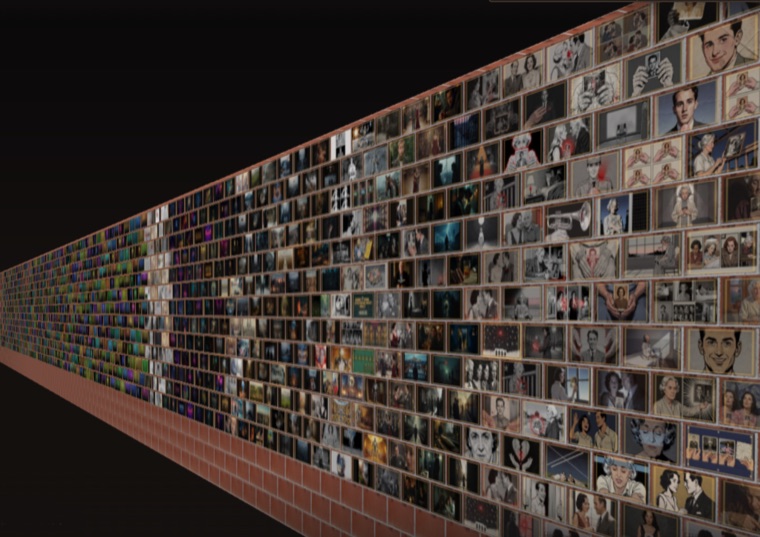
The mosaic and the endless wall. Both are engines that take the archive as input and return an experience. Neither contains any generative component — they are composed entirely of the artist's own photographs. They are, in effect, instruments for reading the notebook, turning 68 years of accumulated record into something that can be looked at whole.
Boxism. The proposed spoof of Cubism: where Cubism implied multiple viewpoints on a flat plane, Boxism maps a single image onto an actual cube and unfolds it into its net. Cubism flattened three dimensions into two by argument; Boxism performs the operation physically and reversibly. It is, structurally, an experiment — a hypothesis about a century-old movement, tested by construction rather than by essay.
6. From studio to software: attribution as notation
The most significant translation of the philosophy into engineering is the attribution feature under development in Dadbot Studio: a complete report of every action taken on a work, distinguishing where the human touched it from where a tool did.
In empiricist terms this is provenance, and provenance is what makes a record epistemically load-bearing. A claim without provenance is an assertion; a claim with it is evidence. Attribution therefore does for the digital work exactly what the catalogue raisonné does for the physical work — and does it automatically, for every user, not just for the artist who has the discipline to maintain 1,950 pages by hand.
Two supporting distinctions follow naturally from the same logic:
Assistive versus generative AI. Demucs (stem separation used to separate the vocal from the instruments) and Whisper (takes the vocal stem and marks the time on each line) are classified as assistive AI rather than generative. The distinction is defensible on empiricist grounds: these instruments analyze what is already there. They separate, align, and measure — the same epistemic role as a microscope or a spectrometer. They do not originate content. Generative tools create new things. When people think of AI they are usually thinking about generative AI. It is the new guy on the block and belongs in a different category because they use models that seem like magic to generate new content.
In Shooster's latest project, www.dadbotstudio.com, he is sensitive to the crowd that wants structure but does not want AI involved in their work. This idea generated a three-mode control. AI Off, Assisted AI, and Generative AI — he named this control the Chromatic Fusion. This is not marketing. The control genuinely is the philosophy instantiated: it lets the user choose their own position on the bridge between the soulful and the scientific, and the attribution report then records honestly what was used.

7. Objections, honestly stated
A framework worth defending is worth attacking first. Three objections deserve answers.
The analogy to science is incomplete. Scientific experiments are testable against an external world; hypotheses can be falsified. Karl Popper argued that falsifiability is precisely what separates science from everything else. An artwork cannot be falsified — nothing about the world contradicts it. So, while the notation transfers cleanly, the testing does not.
The strongest reply is that Chromatic Fusionism never claimed the testing half. Its claim is narrower and survives the objection: the record enables learning regardless of whether it enables refutation. The artist compares this year's work to the last decade's and infers. That is induction — and induction is what the notebook was always for.
Recording can substitute for making. There is a real failure mode in which documentation becomes the work and the studio goes quiet. The catalogue is evidence against this happening here (1,950 pages implies a great deal of recorded output), but the risk is permanent and worth naming.
Learning is not the only value at stake. If success was never the goal, the framework offers no account of quality — of why one work is better than another. It guarantees the artist grows; it says nothing about whether anyone should care. This is arguably fine, since the framework was built to answer a different question, but it should not be mistaken for a complete aesthetics.
8. Conclusion
Chromatic Fusionism is usually presented as a style — vibrant color, shape, and technology, drawing on nature, travel, tribal cultures, and music. That description is accurate and insufficient.
Beneath the style is a method, and beneath the method is a position in a four-hundred-year-old argument about how anyone knows anything. The position is empiricist: experience over pure reason, evidence over assertion, and above all the record as the instrument that converts activity into knowledge.
What distinguishes it is not novelty in philosophy — Bacon got there in 1620 — but the domain. Empiricism was built for natural philosophy and has been applied to nearly everything since, with one conspicuous exception. Fine art, the field that most loudly insists it has no method, has largely refused it.
Chromatic Fusionism is the application. The catalogue raisonné is its notebook, the artworks are its experiments, and the attribution engine now under construction is the attempt to hand the same instrument to everyone else.
Prepared for Stephen Shooster (Shoosty), September 2026.