How much AI is too much? Put it on a dial
There's no universal line — so stop hunting for one and put it on a dial. Decide per project how much AI you want: none, assistive only, or generative. Then record the choice so the work is honest about it.
Why the question has no fixed answer
"How much AI is too much" assumes there's one right amount for everyone. There isn't. A songwriter who wants a machine nowhere near the melody and a producer who wants help separating stems are both right — for their work. The mistake is treating a personal boundary as a universal rule.
Three honest settings
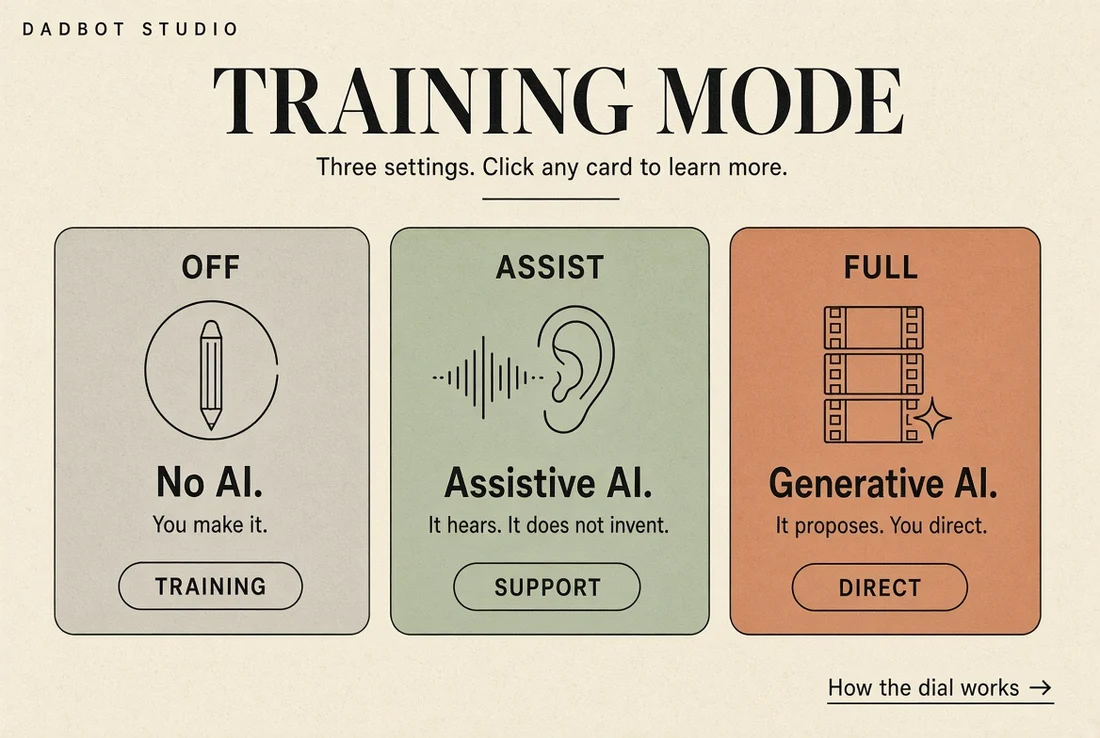
Almost every creative choice about AI fits on a three-position dial:
- —Off — No AI. You make it. The tool stays out of the work entirely.
- —Assist — Assistive AI. It hears; it does not invent. Analysis, separation, alignment — a microscope, not a co-writer.
- —Full — Generative AI. It proposes; you direct. New material enters, under your judgment.
Why the dial beats the debate
A dial replaces an unwinnable argument with a decision you can make in a second and change any time. It also does something the debate can't: paired with an honest record of what you used, it lets the work state its own position instead of leaving viewers to guess.
The tool
In Dadbot Studio this dial is real — we call it the Chromatic Fusion control. Choose Off, Assist, or Full per project, and the attribution report records what was actually used. The right amount of AI is the amount you chose on purpose and were honest about.